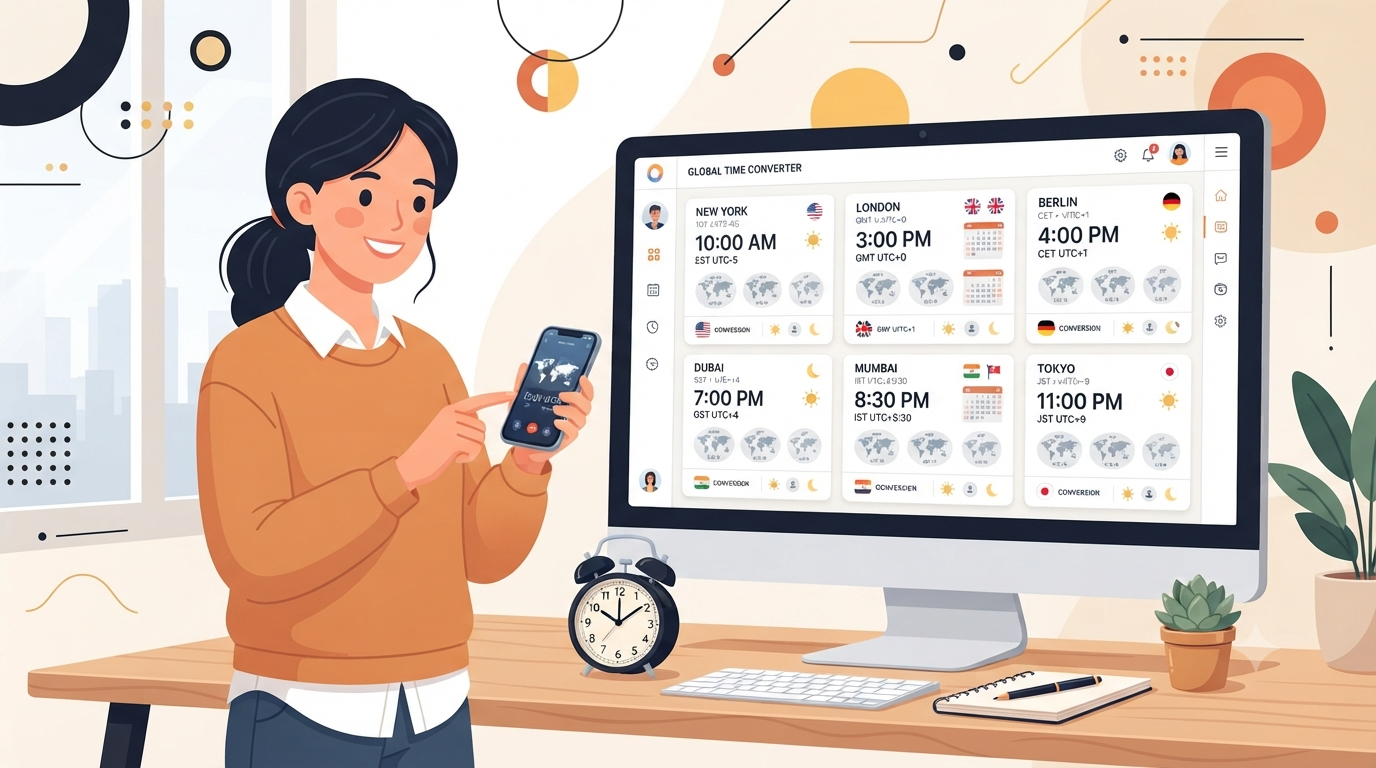
In today, connected world, people work, study, travel, and communicate across different countries every day. Whether you're scheduling a virtual meeting, planning an international trip, or simply calling a friend overseas, understanding time differences is essential. That's where a time zone converter becomes an invaluable tool.
Instead of manually calculating time differences and worrying about daylight saving changes, a reliable time zone converter provides accurate results in seconds. It helps eliminate confusion, prevents missed appointments, and makes global communication much easier.
This guide explains what a time zone converter is, how it works, why it's useful, and how you can use one to simplify your daily activities.
What Is a Time Zone Converter?
A time zone converter is an online tool that converts the current or selected time from one location to another. By selecting your local city and the destination city, the converter instantly displays the corresponding time.
Unlike manual calculations, modern converters automatically account for:
- UTC offsets
- Daylight Saving Time (DST)
- Regional time changes
- Half-hour and quarter-hour time zones
This ensures you always receive an accurate conversion without needing to memorize global time differences.
Why People Use Time Zone Converters
Time zone converters serve a wide range of personal and professional purposes. Here are some of the most common reasons people rely on them.
International Business Meetings
Companies often have employees, clients, and partners spread across multiple countries. A time zone converter helps schedule meetings that work for everyone without confusion.
Remote Work
With remote work becoming increasingly common, teams frequently collaborate across continents. Converting meeting times accurately ensures everyone joins at the correct hour.
Freelancers and Agencies
Freelancers often work with clients in different parts of the world. Knowing the client's local time helps avoid late-night calls or missed deadlines.
Travel Planning
International travelers use time zone converters to plan flights, hotel check-ins, transportation, and itineraries. Knowing the local time before arriving helps reduce travel stress.
Online Events
Webinars, virtual conferences, and online classes usually announce schedules in one time zone. A converter quickly shows when the event begins in your local area.
Family and Friends Abroad
Whether you have relatives living overseas or friends studying abroad, a converter helps you choose the best time to call without interrupting their sleep or work.
How to Use a Time Zone Converter
Most online time zone converters are designed to be simple and user-friendly.
Follow these steps:
- Select your current city or time zone.
- Choose the destination city or country.
- Enter the desired date and time if needed.
- View the converted time instantly.
- Compare multiple locations for international meetings.
Many advanced converters also allow users to compare several cities simultaneously, making it easier to coordinate events involving participants from different countries.
Understanding Time Zones
To understand how a time zone converter works, it helps to know the basics of global timekeeping.
The Earth is divided into 24 primary time zones, each generally representing one hour of difference from the next. These zones are based on the Earth's rotation and its longitude.
Most time zones are measured relative to Coordinated Universal Time (UTC), the global standard for time.
Here are some common examples:
|
City |
Standard Time Zone |
|
New York |
UTC−5 |
|
London |
UTC±0 |
|
Dubai |
UTC+4 |
|
Tokyo |
UTC+9 |
|
Sydney |
UTC+10 |
|
New Delhi |
UTC+5:30 |
Notice that not every country follows whole-hour offsets. India, for example, uses UTC+5:30, while some regions use even 45-minute differences.
This is why automatic conversion tools are much more reliable than manual calculations.
Daylight Saving Time Explained
One of the biggest challenges in time conversion is Daylight Saving Time (DST).
DST is the practice of moving clocks forward by one hour during warmer months to extend daylight in the evening.
However, not every country follows Daylight Saving Time.
For example:
- The United States observes DST in most states.
- Canada follows DST in many provinces.
- Most European countries observe DST.
- India does not observe DST.
- Japan does not observe DST.
- The United Arab Emirates does not observe DST.
Because DST begins and ends on different dates depending on the country, manually calculating time differences can become confusing.
A good time zone converter automatically adjusts for these seasonal changes, ensuring the displayed time is always accurate.
Common Time Zone Conversion Examples
People frequently search for specific time conversions rather than general time differences.
Some popular examples include:
- EST to PST
- GMT to IST
- UTC to CET
- London to New York
- New York to Dubai
- California to India
- Sydney to Singapore
- Tokyo to Los Angeles
Instead of memorizing these differences, a converter provides instant and accurate results for any location worldwide.
Features to Look for in a Good Time Zone Converter
Not all online converters offer the same level of functionality. When choosing one, look for features that improve accuracy and convenience.
Automatic Daylight Saving Updates
The converter should automatically detect DST changes without requiring manual adjustments.
Multiple City Comparison
Comparing several cities at once is useful for international meetings and project planning.
Mobile-Friendly Design
A responsive interface allows you to convert times easily from your smartphone, tablet, or desktop.
World Clock Integration
Many converters include live clocks for major cities, helping users quickly compare current times.
Accurate UTC Support
Reliable UTC calculations ensure conversions remain consistent across all regions.
Fast Performance
A quality converter should display results instantly without unnecessary complexity.
Tips for Scheduling International Meetings
Scheduling meetings across different countries requires more than simply converting the time.
Here are some practical tips:
Consider Working Hours
Aim to schedule meetings during standard business hours for all participants whenever possible.
Double-Check Daylight Saving Time
If participants are located in countries that observe DST, verify whether recent clock changes affect the meeting time.
Use Calendar Invitations
Send invitations that automatically convert to each attendee's local time.
Confirm the Time Zone
When communicating meeting details, always mention the time zone.
For example:
- 3:00 PM UTC
- 10:00 AM EST
- 6:00 PM GST
This reduces confusion among international attendees.
Avoid Very Early or Late Meetings
Rotating meeting times can help distribute inconvenience fairly among global teams.
Common Mistakes When Converting Time Zones
Even experienced professionals sometimes make errors when scheduling across countries.
Some common mistakes include:
- Forgetting Daylight Saving Time
- Assuming every country follows whole-hour offsets
- Using outdated UTC differences
- Confusing AM and PM
- Mixing local time with UTC
- Scheduling meetings without confirming participants' locations
Using an accurate online converter helps eliminate these issues.
Frequently Asked Questions
What is the best time zone converter?
The best time zone converter is one that provides accurate conversions, automatically updates for Daylight Saving Time, supports multiple locations, and offers a simple, user-friendly interface.
Does a time zone converter account for Daylight Saving Time?
Yes. Most modern converters automatically adjust for Daylight Saving Time, ensuring accurate results throughout the year.
Is UTC the same as GMT?
UTC (Coordinated Universal Time) and GMT (Greenwich Mean Time) are closely related and often used interchangeably for everyday purposes. However, UTC is the international standard used for precise global timekeeping.
Can I compare multiple time zones at once?
Many advanced converters allow you to compare several cities simultaneously, making it easier to schedule international meetings or events.
Why do some countries have 30-minute or 45-minute time differences?
Some countries and regions use non-standard UTC offsets based on historical, political, or geographical reasons. For example, India follows UTC+5:30, while Nepal uses UTC+5:45.
Conclusion
As businesses become more global and people communicate across borders every day, accurately converting time has never been more important. Whether you're coordinating an international meeting, planning travel, attending an online event, or staying connected with friends and family abroad, a dependable time zone converter saves time and prevents costly scheduling mistakes.
Instead of manually calculating time differences or worrying about Daylight Saving Time, use a reliable converter to get instant, accurate results. With features like automatic DST adjustments, multiple city comparisons, and real-time world clocks, a modern time zone converter makes managing global schedules simple and stress-free.